
Business leaders spend enormous effort protecting the assets that keep their organizations running.
Financial reserves are monitored. Cybersecurity systems are strengthened. Key talent is retained. Risks are identified and managed.
But one critical asset rarely appears on the balance sheet:
The brain of the person making the decisions.
Every strategy you formulate, difficult conversation you navigate, risk you evaluate, and decision you make depends on how well your brain is functioning.
Yet many leaders expect this asset to operate at full capacity despite insufficient sleep, constant stress, back-to-back meetings, digital overload, poor nutrition, and very little genuine recovery.
You wouldn’t run a critical piece of machinery continuously without maintenance.
Why should we expect the executive brain to operate differently?
Leadership Is Brain Work
Modern leadership is increasingly cognitive.
Throughout a typical day, your brain must analyze information, prioritize competing demands, regulate emotions, solve problems, communicate clearly, assess risks, and make decisions under uncertainty.
Much of this depends on the prefrontal cortex—the region involved in higher-order functions such as planning, attention, judgment, impulse control, and decision-making.
These are precisely the abilities we expect from good leaders.
But they are not unlimited resources.
Leadership isn’t only about what you know.
It is also about the condition of the brain accessing and applying what you know.
A Capable Leader Can Still Have a Low-Capacity Day
Consider two executives with the same experience, knowledge, and leadership capability.
One slept well, ate appropriately, moved during the day, managed stress effectively, and arrived mentally recovered.
The other slept five hours, woke to urgent messages, spent six hours in meetings, relied heavily on caffeine, and barely stopped all day.
Their capability may be identical.
Their capacity to use that capability may not be.
A highly experienced leader operating with reduced cognitive capacity can become more reactive, overlook important information, struggle to maintain attention, and make poorer decisions.
The knowledge hasn’t disappeared.
The brain’s ability to deploy it effectively has changed.
This is why brain health isn’t simply about preventing cognitive decline decades from now.
It is about protecting performance today.
What Is Quietly Draining the Executive Brain?
Several features of modern leadership can gradually reduce cognitive performance without producing an obvious warning signal.
1. Insufficient Sleep
Sleep isn’t simply downtime. It supports memory, learning, emotional regulation, and restoration.
A sleep-deprived executive may still answer emails, attend meetings, and make decisions.
But functioning isn’t the same as performing optimally.
The better question is:
Are you doing those things with the same quality of judgment, attention, creativity, and emotional control?
2. Chronic Stress
Short-term stress can sharpen performance. Persistent stress is different.
When the brain remains in a prolonged state of alert, leaders can gradually shift from:
Strategic thinking → immediate problem solving
Thoughtful response → rapid reaction
Long-term perspective → short-term survival
The danger is that this change often happens gradually.
3. Digital Overload
Emails. Messages. Notifications. Video calls. Dashboards.
Each interruption seems small, but collectively they create a fragmented cognitive environment.
A calendar packed with activity may look productive while leaving almost no space for deep thinking.
For a senior leader, your greatest contribution may not be answering another 30 messages.
It may be having enough cognitive space to recognize the one problem nobody else has noticed.
4. Poor Metabolic Health
The brain is highly metabolically active.
Large fluctuations in energy, poor nutrition, inadequate movement, insulin resistance, and chronic inflammation can influence how energetic and mentally sharp we feel.
This is why brain health cannot be completely separated from metabolic health.
The quality of your thinking is influenced by the biological environment supporting your brain.
5. Inadequate Recovery
Many executives stop working without actually recovering.
They leave the office but continue checking messages. They eat dinner while discussing work. They scroll through their phones until bedtime.
Their body may have left work.
Their brain hasn’t.
Without sufficient recovery, yesterday’s load becomes today’s starting point.
Watch for the Early Signals
Declining cognitive performance rarely announces itself dramatically.
Instead, you may notice that:
- Concentrating takes more effort.
- Small interruptions irritate you.
- You reread information several times.
- You increasingly depend on caffeine.
- Complex decisions feel unusually exhausting.
- You struggle to switch off after work.
- Creative thinking becomes harder.
- You stay busy all day but accomplish less meaningful work.
These don’t automatically mean something is wrong.
But they may indicate that your performance demands are beginning to exceed your recovery capacity.
Protect Your Brain Like a Business Asset
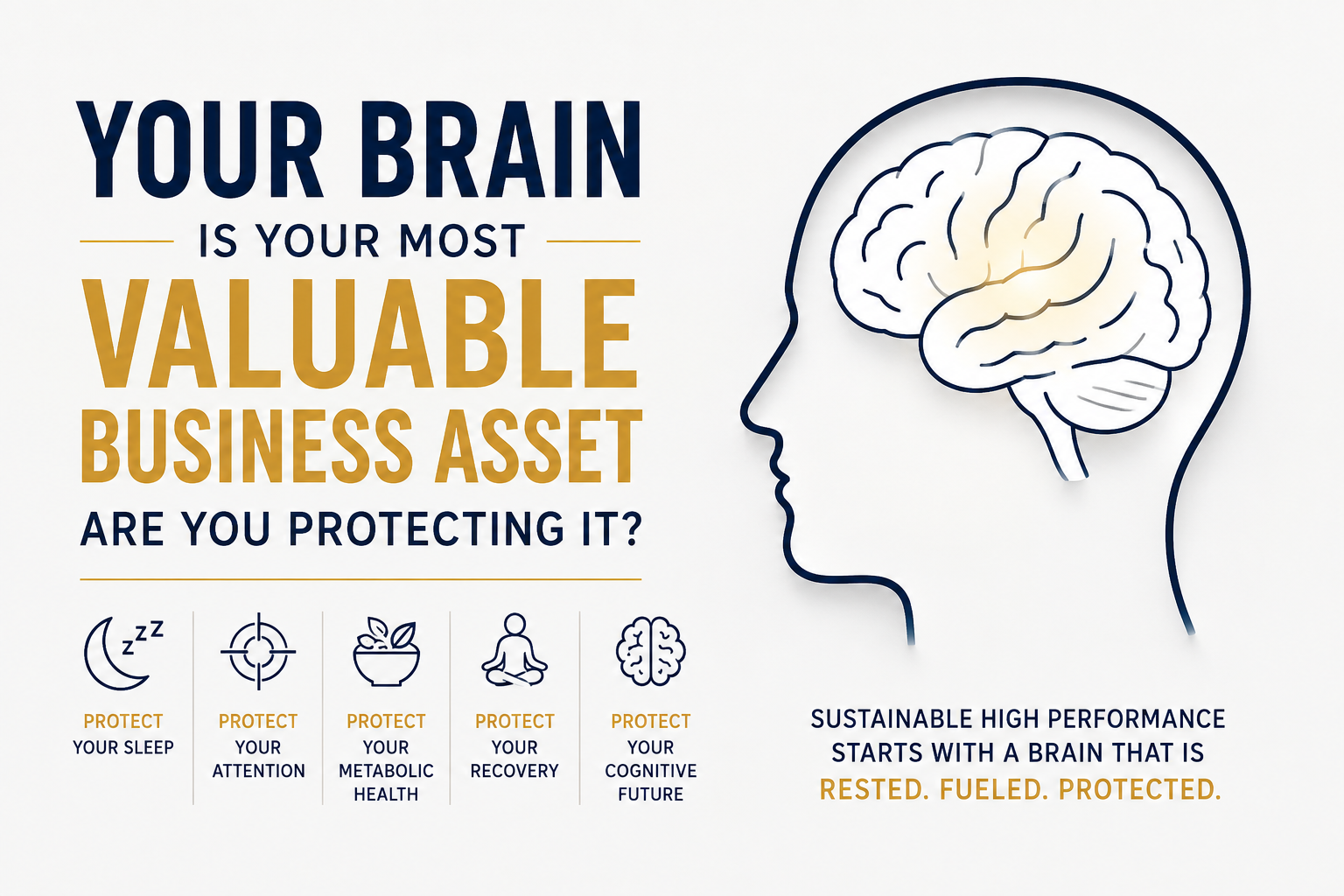
If your brain is one of your most valuable professional assets, protecting it deserves intentional attention.
Protect your sleep.
Don’t treat sleep as whatever time remains after everything else is finished. Consistent, sufficient sleep provides the foundation for cognitive and emotional performance.
Protect your attention.
Not every notification deserves immediate access to your brain. Create periods for uninterrupted thinking and reduce unnecessary cognitive switching.
Protect your metabolic health.
Pay attention to how nutrition, movement, hydration, and meal timing affect your energy and concentration throughout the day.
Protect your recovery.
Recovery doesn’t only happen during vacations. Short walks, screen breaks, breathing resets, and genuine pauses between demanding tasks can help reduce accumulated load.
Protect your cognitive future.
Brain health shouldn’t begin when memory problems appear. Sleep, movement, metabolic health, learning, social connection, and stress management all contribute to the environment in which your brain ages.
Beyond Time Management: Capacity Management
For decades, leaders have been taught to manage time.
But everyone receives the same 24 hours.
What differs is the capacity we bring into those hours.
One executive enters a critical meeting rested, focused, metabolically stable, and emotionally regulated.
Another enters the same meeting sleep-deprived, stressed, distracted, and mentally exhausted.
Both have sixty minutes.
They don’t necessarily have sixty minutes of equivalent cognitive performance.
Perhaps the next evolution of leadership performance isn’t simply better time management.
It is better capacity management.
Brain Health Is a Leadership Strategy
Brain health is often treated as something to worry about later in life.
For leaders, that definition is too narrow.
Brain health influences what happens today:
How clearly you think.
How well you listen.
How calmly you respond.
How creatively you solve problems.
How accurately you assess risk.
And ultimately, the quality of the decisions that shape your organization.
Your brain doesn’t appear on your company’s balance sheet.
But few assets influence the future of the business more.
So instead of asking:
“Can I keep pushing?”
Perhaps the better question is:
“Am I protecting the brain that my leadership depends on?”
Because sustainable high performance isn’t simply about asking more from your brain.
It’s about creating the conditions that allow your brain to keep giving you its best.