
Imagine this.
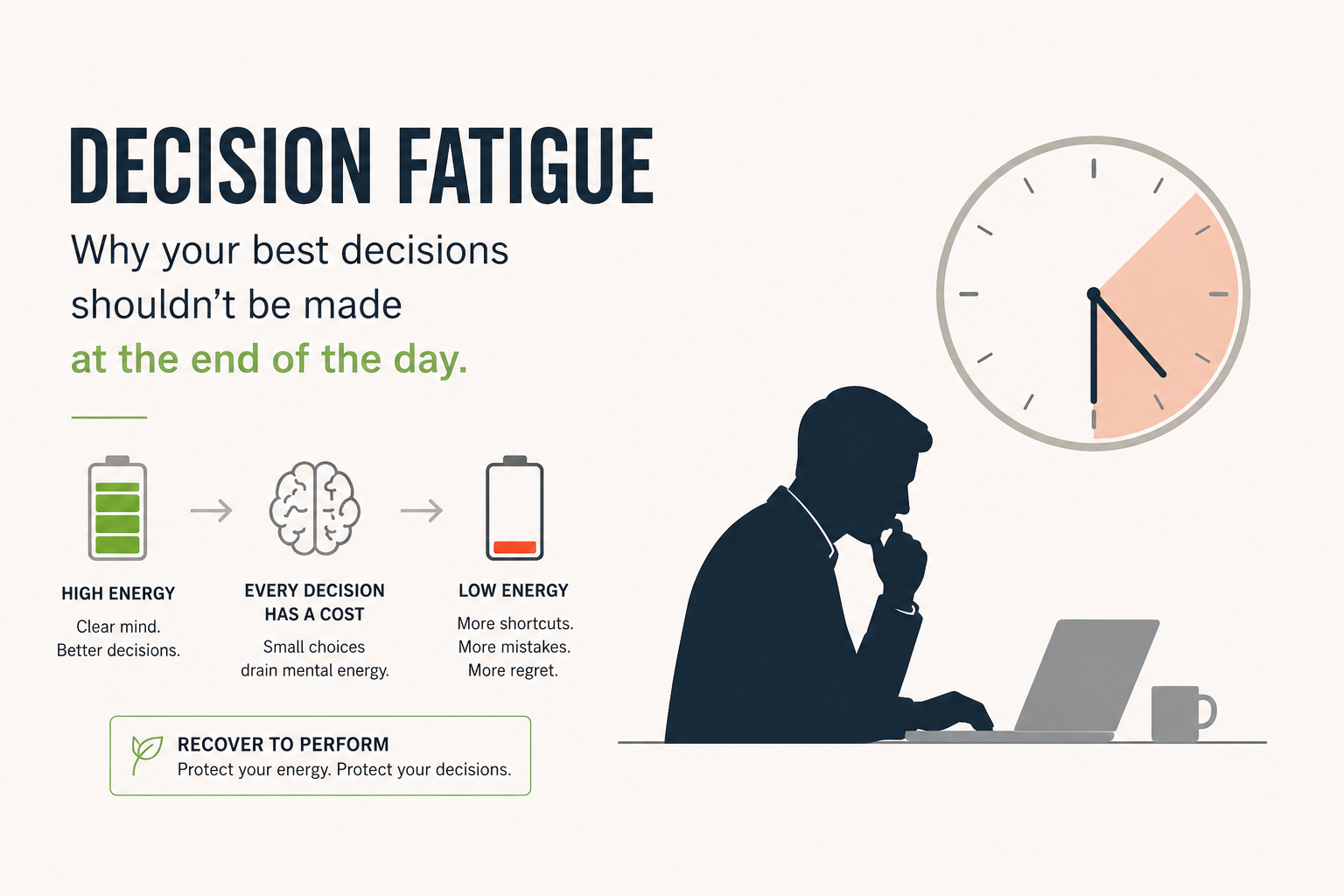
It’s 5:30 PM.
You’ve already attended six meetings, responded to countless emails, solved unexpected problems, and made dozens of decisions—both big and small.
Then one final decision lands on your desk.
It seems straightforward.
So you approve it.
Only later do you realize it wasn’t your best decision.
The problem wasn’t your experience.
It wasn’t your intelligence.
It was your mental energy.
Every Decision Has a Cost
Leadership is often described as decision-making.
But few people realize that every decision—whether significant or trivial—draws from the same mental reserve.
Should I respond to this email now?
Should I approve this proposal?
Should I challenge this idea?
Should I have another meeting?
Individually, these choices seem insignificant.
Collectively, they create what psychologists call decision fatigue.
The more decisions we make, the harder it becomes to make good ones.
Our brains naturally look for shortcuts.
We become more impulsive.
Or we avoid making decisions altogether.
Neither is ideal for effective leadership.
It’s Not Just Big Decisions That Matter
Many leaders assume that mental fatigue only comes from major strategic decisions.
In reality, it’s often the accumulation of hundreds of small decisions throughout the day that drains our capacity.
What to wear.
Which email to answer first.
Whether to accept another meeting.
How to respond to a difficult conversation.
These seemingly minor choices quietly consume mental resources.
By late afternoon, your brain may be operating on a much smaller reserve than you realize.
Why Recovery Matters
We often think of recovery as something that happens after work.
But effective leaders recover throughout the day.
A short walk between meetings.
Five minutes of quiet reflection.
Looking away from the screen.
Taking a proper lunch break.
These moments aren’t wasted time.
They’re opportunities to replenish the mental capacity required for better decisions.
Recovery isn’t the reward for productivity.
It’s what makes productivity possible.
Design Your Day Around Your Brain
Many executives schedule their calendar around other people’s priorities.
Recovery Engineers schedule around cognitive performance.
Reserve your highest-energy hours for your most important decisions.
Group routine tasks together.
Reduce unnecessary choices.
Create space between demanding meetings.
Protect time for strategic thinking rather than filling every available minute.
The goal isn’t to do more.
The goal is to think better.
The Hidden Advantage
Organizations invest heavily in better technology, better processes, and better data.
But every one of those investments still depends on one thing:
The quality of human judgment.
And judgment depends on mental energy.
Leaders who understand this gain an advantage that isn’t visible on a balance sheet.
They make fewer impulsive decisions.
They remain calmer under pressure.
They solve problems more creatively.
They lead with greater consistency.
Not because they know more.
But because they have protected the capacity to think clearly.
Final Thought
The most successful leaders don’t simply manage their calendars.
They manage their cognitive capacity.
Because every decision you make draws from a limited reserve.
Spend it wisely.
And when that reserve begins to run low, don’t just push harder.
Recover.
Your next decision may depend on it.