
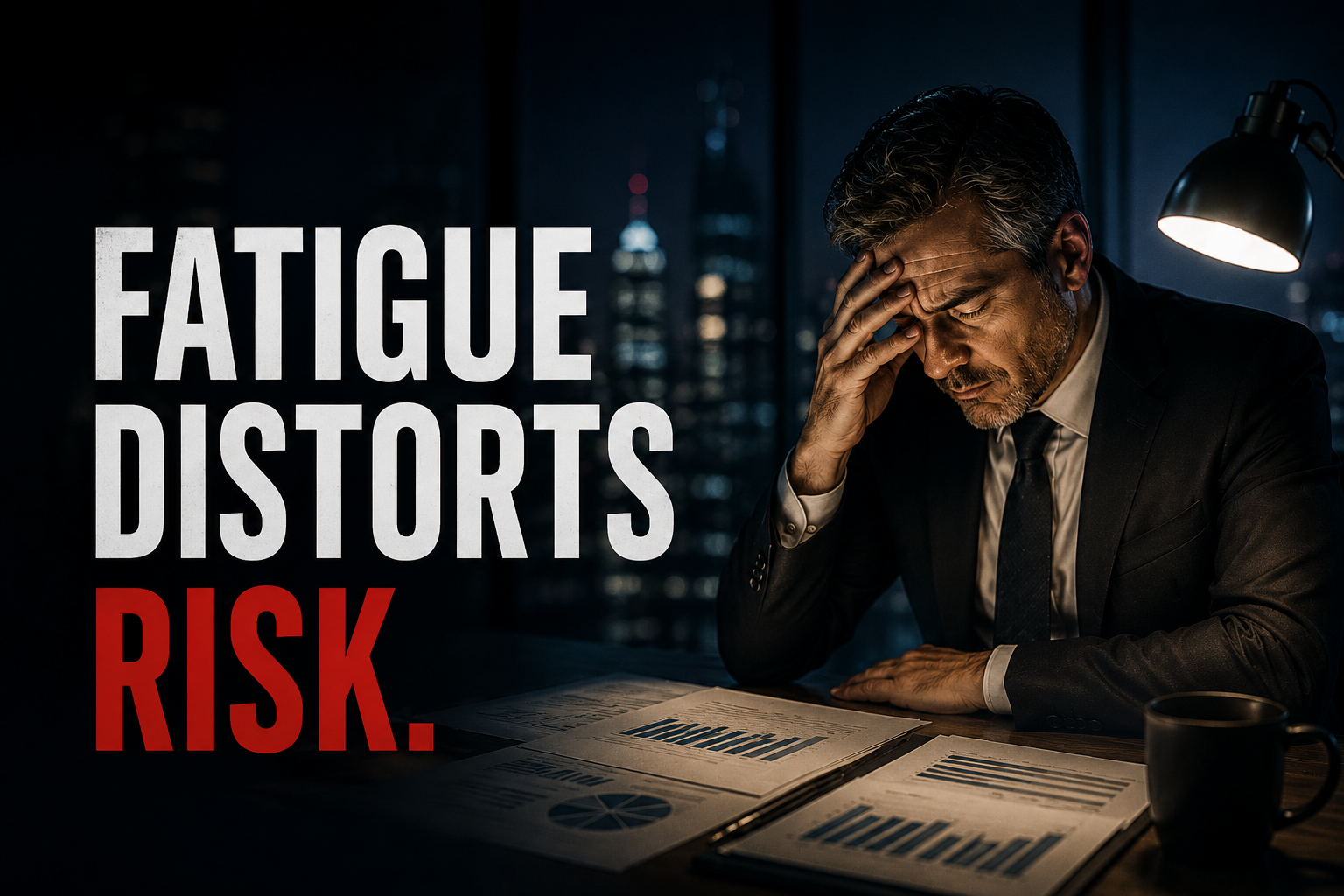
We spend enormous amounts of time managing business risks.
We build governance systems, conduct scenario planning, establish approval processes, and review financial projections.
Yet there is one risk factor that rarely appears on any executive dashboard:
The state of the leader making the decision.
When people are tired, they don’t simply feel less energetic.
They think differently.
They assess risk differently.
And sometimes, they become dangerously confident in decisions that deserve greater caution.
The greatest business risks are often not caused by a lack of information.
They are caused by exhausted minds interpreting that information.
When Fatigue Changes the Way We Think
Modern neuroscience tells us that sleep deprivation affects the prefrontal cortex—the part of the brain responsible for judgment, strategic thinking, emotional regulation, and impulse control.
In practical terms, this means tired leaders often experience three subtle but important changes.
First, optimism can turn into overconfidence.
Research suggests that sleep-deprived individuals become more focused on potential rewards while paying less attention to possible losses. Opportunities appear larger. Warning signs appear smaller.
What feels like confidence may actually be fatigue.
Second, strategic thinking narrows.
Well-rested leaders are comfortable with complexity. They ask difficult questions:
- What if our assumptions are wrong?
- What are we not seeing?
- What could go wrong?
Tired brains, however, prefer simpler answers. They seek certainty and quick conclusions.
Tunnel vision replaces strategic flexibility.
Third, emotional regulation weakens.
Minor disagreements become frustrating.
Patience declines.
Constructive criticism feels more threatening.
The very moments that require calm leadership often occur when leaders are running on empty.
The Dangerous Illusion of Adaptation
Perhaps the most concerning part of chronic sleep loss is that people eventually stop noticing its effects.
After weeks of sleeping too little, many professionals genuinely believe they have adapted.
They feel normal.
They feel productive.
They believe they are functioning at their usual level.
Unfortunately, the science tells a different story.
Performance continues to decline even when our awareness of that decline stops increasing.
Reaction times slow.
Working memory weakens.
Decision-making becomes less balanced.
Yet confidence remains intact.
The challenge is simple:
You cannot accurately judge impairment using the very brain that has been impaired.
That is why fatigue is such a dangerous leadership issue.
The tired leader is often the last person to realize they are tired.
Risk Management Begins With Recovery
Organizations work hard to protect their financial capital, intellectual property, and operational systems.
Perhaps it is time to protect cognitive capital with the same seriousness.
After all, every major decision passes through the human brain.
And the quality of that brain matters.
This does not mean leaders need perfect sleep every single night.
Business is demanding. Travel happens. Deadlines exist.
But recovery should never be treated as optional.
Three simple principles can help.
Don’t Make Important Decisions When Exhausted
Not every decision needs to happen immediately.
Sometimes the highest-return investment is one good night’s sleep.
The quality of tomorrow’s decision may be far greater than the speed of today’s.
Invite More Dissent
Fatigue naturally increases confidence while reducing curiosity.
Counter this by asking:
What are we missing?
What assumptions should we challenge?
What is the downside scenario?
Fresh perspectives often reveal risks that tired minds overlook.
Treat Sleep as Leadership Infrastructure
Sleep is not merely a wellness habit.
It supports strategic thinking.
It strengthens emotional regulation.
It improves judgment.
It enhances creativity.
In many ways, sleep is part of an organization’s risk-management system.
Because leaders do not make decisions in spite of biology.
They make decisions through biology.
A Different View of High Performance
Modern business culture often celebrates endurance.
The ability to work longer.
Push harder.
Sleep less.
Always be available.
But sustainable high performance is not about enduring exhaustion.
It is about preserving decision quality.
The most effective leaders are not necessarily the people who work the hardest.
They are the people who consistently think clearly when the stakes are highest.
And clear thinking requires recovery.
The next time an important decision lands on your desk, perhaps the question should not simply be:
“Do we have enough information?”
Perhaps we should also ask:
“Are we in the right condition to interpret it wisely?”
Because good risk management does not begin in the boardroom.
It begins the night before.