
There is a belief deeply embedded in modern work culture:
The people who succeed are the ones who can keep going when everyone else stops.
Long hours are celebrated.
Exhaustion is admired.
Sleep is treated as a luxury rather than a necessity.
But if we look at the world’s best performers, we see a very different story.
Elite athletes do not train harder by recovering less.
They train harder because they recover better.
And perhaps leaders should do the same.
The Corporate Athlete Mindset
Executives may not compete on running tracks or football fields, but they operate under enormous pressure every day.
They make decisions with incomplete information.
They manage uncertainty.
They regulate emotions during difficult conversations.
They lead teams through constant change.
In many ways, today’s leaders are corporate athletes.
The difference is that their performance depends less on physical energy and more on mental and emotional capacity.
Strategic thinking.
Judgment.
Creativity.
Patience.
Emotional intelligence.
These are the tools of modern leadership.
And all of them require recovery.
Yet many organizations continue to reward endurance rather than restoration.
The irony is difficult to ignore:
No professional athlete would proudly announce that they only sleep four hours a night.
No elite coach would design a training program without recovery days.
Because athletes understand something fundamental:
Performance is built during recovery, not during stress itself.
The same principle applies to leadership.
Recovery Is Not the Opposite of Performance
Many people still see rest as inactivity.
Time away from work is viewed as lost productivity.
Sleep is something to squeeze in after everything else is completed.
But biology operates differently.
The brain consolidates learning during sleep.
Emotional balance is restored through recovery.
Creative insights often emerge when the mind is allowed to rest.
The very capabilities that define great leadership depend on periods of restoration.
Without recovery, performance does not remain stable.
It gradually declines.
The issue is not working hard.
Hard work matters.
The issue is working hard without allowing the system to recover.
Eventually, demand outpaces capacity.
And when that happens, burnout is not far behind.
A Different Way to Think About Performance
Organizations spend enormous resources developing talent.
Leadership programs.
Technical training.
Professional certifications.
Strategic frameworks.
These investments are important.
But there is another part of the equation that is often ignored:
Performance = Skill × Recovery
No matter how capable someone becomes, their abilities can only be expressed through a biological system that has sufficient energy and resilience.
A highly skilled but exhausted leader will never perform at their true potential.
A well-recovered leader can.
The difference is not talent.
The difference is capacity.
And capacity must be renewed.
Burnout Is Not a Badge of Honor
Somewhere along the way, exhaustion became associated with commitment.
People proudly talk about working weekends.
Sleeping less.
Always being available.
Pushing through fatigue.
But burnout is not evidence of excellence.
It is evidence that recovery has fallen behind demand.
Imagine asking an Olympic athlete to train at maximum intensity every single day without rest.
Performance would not improve.
Injury would follow.
Yet many professionals attempt exactly this with their minds.
Meetings fill every hour.
Emails continue late into the night.
Global schedules eliminate boundaries between work and rest.
And then we wonder why creativity declines and decision-making suffers.
The problem is rarely a lack of ambition.
The problem is a lack of recovery.
The Leaders Who Last Think Differently
The most effective leaders understand that recovery is not something that happens accidentally.
It must be designed intentionally.
That might mean protecting sleep.
Creating boundaries around technology.
Taking genuine breaks during the workday.
Writing tomorrow’s priorities before leaving the office.
Spending time with family without digital interruptions.
These actions may appear simple.
But they are performance strategies.
Recovery is not a reward for hard work.
It is what makes hard work sustainable.
The leaders who thrive over decades are not necessarily the ones who push the hardest every day.
They are the ones who know when to rest, reset, and return stronger.
The Future Belongs to Recovery Engineers
For years, leadership conversations focused heavily on time management.
How to prioritize.
How to schedule.
How to optimize productivity.
But perhaps the next frontier is energy management.
The future belongs to leaders who understand how to manage stress and recovery as a system.
Who recognize that resilience is not the ability to absorb unlimited pressure.
It is the ability to recover effectively after pressure.
Because human beings are not machines.
We operate through rhythms.
Effort and restoration.
Challenge and adaptation.
Performance and recovery.
Ignoring these rhythms does not create stronger leaders.
It creates tired ones.
Recovery Is Part of the Performance
Elite athletes learned this lesson long ago.
Business leaders are only beginning to catch up.
The goal is not to work less.
The goal is to perform better, for longer, and more sustainably.
The question is no longer:
“How much more can I endure?”
The better question is:
“How well am I recovering?”
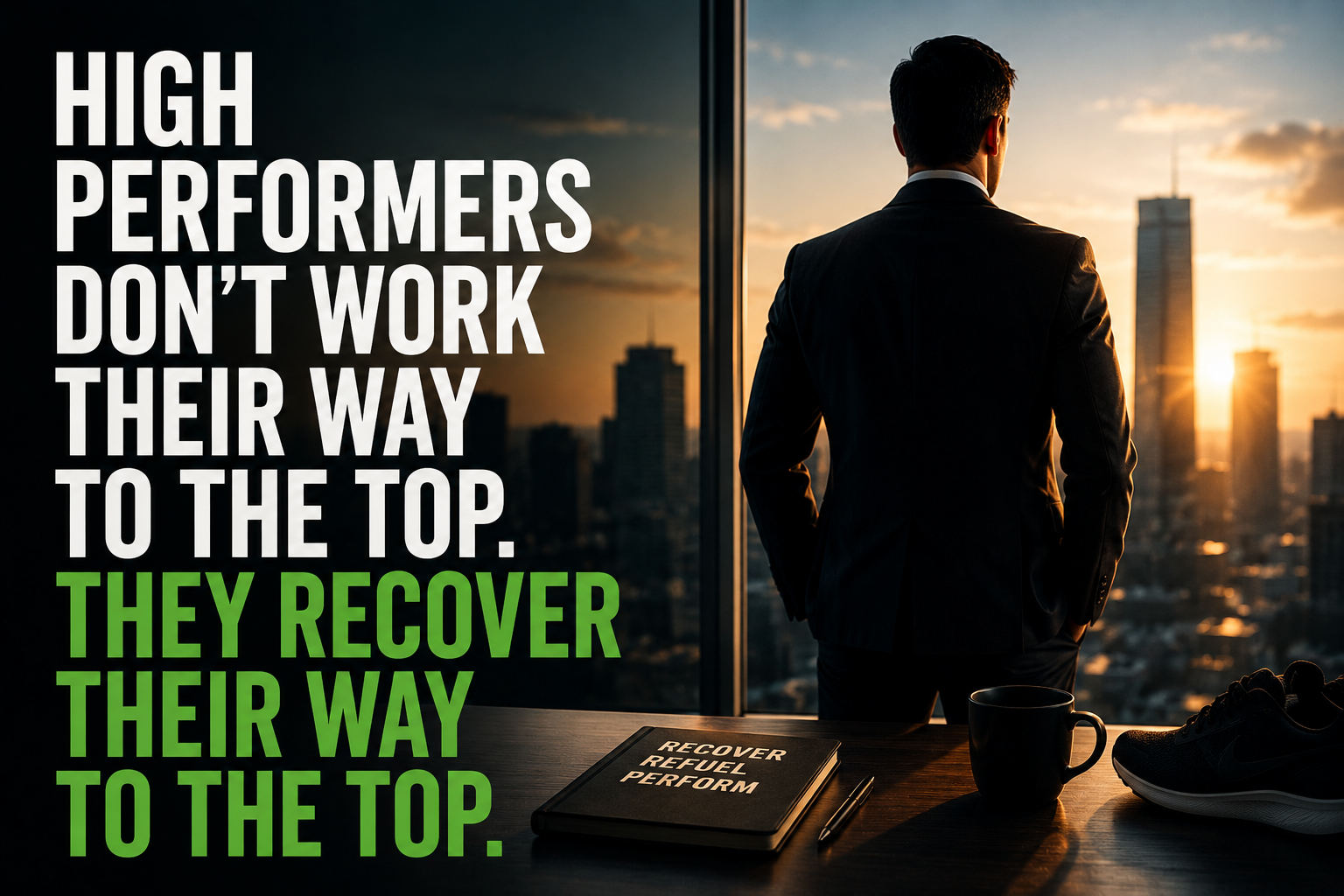
Because high performers don’t work their way to the top.
They recover their way to the top.