
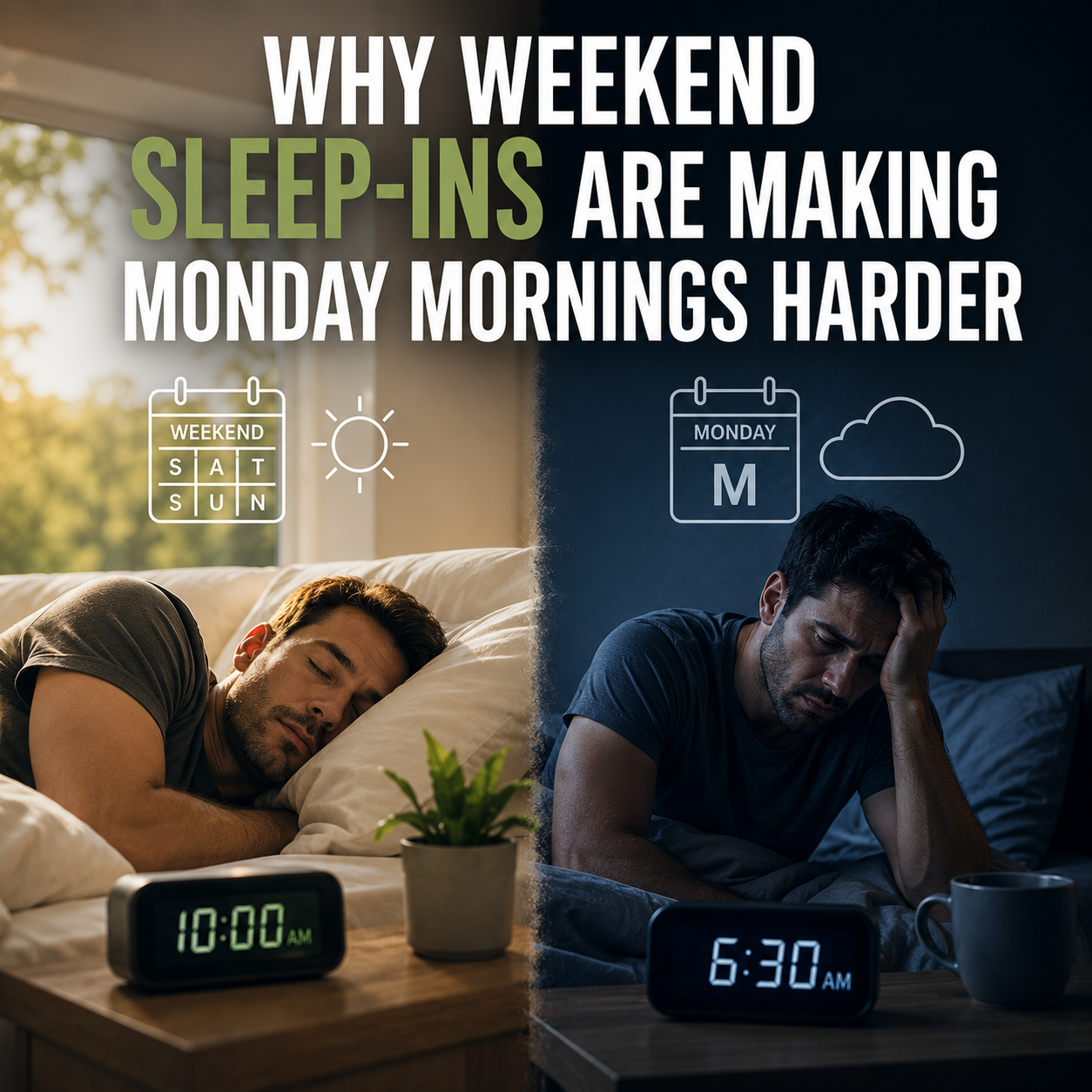
For many professionals, the weekend follows a familiar pattern.
Monday to Friday:
Wake up early.
Rush to work.
Push through meetings.
Stay productive.
Accumulate fatigue.
Then Saturday arrives.
Finally, an opportunity to catch up on sleep.
So you sleep in.
Maybe until 9AM.
Maybe 10AM.
Sometimes even later.
It feels wonderful.
And it feels productive.
After all, sleep is good for you.
Right?
Not always.
Because the very thing that feels like recovery on Saturday morning may be making Monday morning significantly harder.
The Weekend Sleep Trap
Most people think sleep is like a bank account.
Sleep less during the week.
Sleep more during the weekend.
Balance restored.
Unfortunately, the body doesn’t work that way.
Sleep is governed by a biological clock known as the circadian rhythm.
This clock thrives on consistency.
Not perfection.
Consistency.
Your brain wants predictable signals about:
- when to wake
- when to eat
- when to move
- when to sleep
When those signals become inconsistent, the clock becomes confused.
And confusion creates fatigue.
What Happens When You Sleep In
Imagine waking up at 6:30AM every weekday.
Then sleeping until 10AM on Saturday and Sunday.
That’s a shift of three and a half hours.
From a biological perspective, that’s similar to flying across several time zones.
Your body clock shifts later.
Melatonin release shifts later.
Sleep pressure shifts later.
Your entire rhythm moves.
Then Monday arrives.
The alarm rings at 6:30AM.
But your body still thinks it’s the weekend.
The result?
Monday morning feels brutal.
Not because you’re lazy.
Not because you lack discipline.
Because your biology is operating on a different schedule.
Social Jet Lag: The Hidden Sleep Disruptor
Researchers call this phenomenon:
Social Jet Lag.
It’s the mismatch between your weekday schedule and your weekend schedule.
Many people experience a form of jet lag every Monday without ever boarding an airplane.
Common symptoms include:
- difficulty waking up
- low energy
- poor concentration
- brain fog
- reduced motivation
- irritability
Sound familiar?
Most people blame Monday.
The real issue often started on Saturday.
Why More Sleep Doesn’t Always Equal Better Recovery
The body needs sufficient sleep.
But it also needs rhythm.
Imagine watering a plant.
The goal isn’t to flood it once a week.
The goal is consistent nourishment.
Sleep works similarly.
A regular seven to eight hours often produces better results than:
- six hours during weekdays
- ten hours during weekends
Consistency helps regulate:
- hormone production
- energy levels
- metabolism
- mood
- cognitive performance
The Leadership Cost
Many professionals underestimate the performance impact of social jet lag.
Poor Monday recovery affects:
Decision-Making
The brain struggles to access higher-order thinking when sleep timing is disrupted.
Emotional Regulation
Small frustrations feel bigger.
Patience decreases.
Reactivity increases.
Productivity
Monday often becomes a “warm-up day” rather than a productive day.
Many professionals lose an entire day of effectiveness simply because their body clock is misaligned.
What To Do Instead
The goal is not to eliminate flexibility.
The goal is to reduce extremes.
Try to keep wake-up times within 60 to 90 minutes of your weekday schedule.
For example:
Weekday: 6:30AM
Weekend: 7:30AM–8:00AM
This allows recovery without creating a major shift in your circadian rhythm.
You can also:
- take short naps if needed
- prioritize earlier bedtimes
- improve sleep quality during the week
- increase morning sunlight exposure
Consistency Beats Catch-Up
Many people spend their weekends trying to recover from their weekdays.
A better strategy is to stop creating such a large sleep debt in the first place.
The healthiest sleep pattern is rarely the most dramatic.
It’s the most consistent.
Because your brain loves rhythm.
Your hormones love rhythm.
Your energy loves rhythm.
And your sleep does too.
Final Thought
Sleeping in on weekends feels good.
But feeling good on Saturday morning isn’t the same as performing well on Monday morning.
The goal isn’t simply more sleep.
The goal is better alignment.
Because sometimes the reason Monday feels so hard…
is what happened on Sunday morning.