
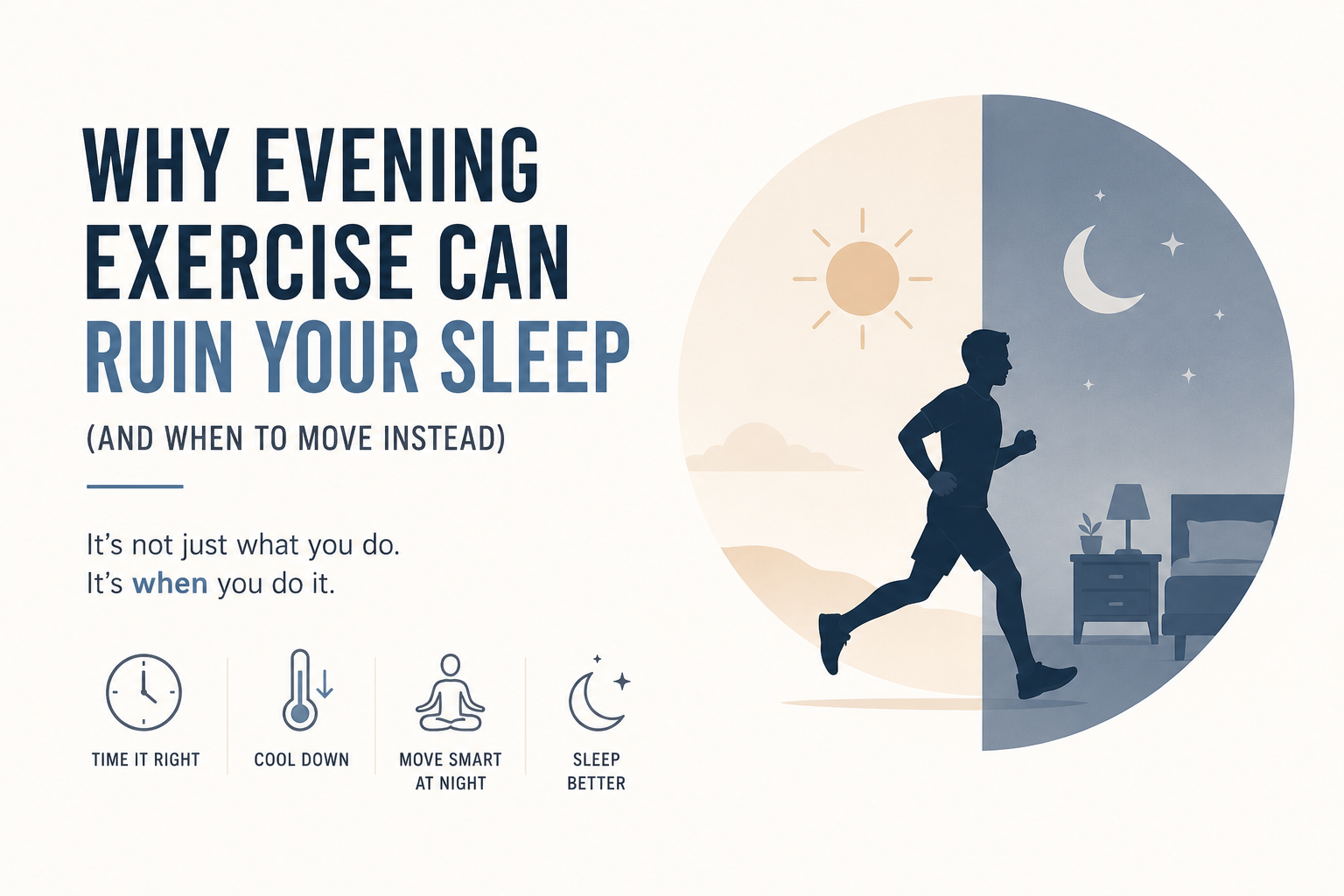
Many people are told:
“Exercise improves sleep.”
And that’s true.
But there’s a detail that often gets missed:
Not all exercise helps sleep.
Timing matters.
Because while movement can support recovery, the wrong type of movement at the wrong time can quietly disrupt it.
1. The Assumption That More Exercise = Better Sleep
For most people, the logic is simple:
- Exercise tires you out
- Being tired helps you sleep
- Therefore, exercising anytime should improve sleep
But the body doesn’t work that way.
Sleep is not triggered by exhaustion alone.
It is triggered by a shift in your physiological state.
And certain types of exercise can delay that shift.
2. What Happens When You Exercise Late at Night
Strenuous exercise activates the body.
This is exactly what it is designed to do.
During intense workouts:
- Heart rate increases
- Core body temperature rises
- Adrenaline is released
- Cortisol levels increase
All of these signals tell the body:
“Stay alert. Stay awake. Stay ready.”
This is excellent for performance.
But it directly conflicts with what the body needs for sleep:
- lower body temperature
- reduced stimulation
- calm nervous system
- declining cortisol
So when intense exercise happens too close to bedtime, the body is left in a state of activation, not recovery.
3. The “Wired but Tired” Effect
This is where many high performers get stuck.
They:
- finish a late workout
- feel physically tired
- expect to fall asleep quickly
But instead, they experience:
- difficulty falling asleep
- light, fragmented sleep
- waking up during the night
- feeling unrefreshed the next day
Why?
Because while the body is tired, the nervous system is still switched on.
This creates the classic state:
Wired but tired.
4. Body Temperature: The Hidden Factor
One of the most important triggers for sleep is a drop in core body temperature.
Your body naturally cools down in the evening to prepare for rest.
But intense exercise does the opposite:
- it raises body temperature
- delays cooling
- interferes with sleep onset
If the body is still “running hot,” it struggles to transition into deeper sleep stages.
This is one of the most overlooked reasons why late-night workouts disrupt sleep.
5. So When Should You Exercise?
To get the benefits of exercise without harming sleep, timing is key.
General guideline:
Finish intense workouts at least 3 hours before bedtime
This gives your body enough time to:
- cool down
- lower cortisol
- shift into recovery mode
For many people, the ideal windows are:
- Morning → energizes the day
- Late afternoon → supports performance without disrupting sleep
6. What You Can Do at Night
Here’s the important distinction:
Not all movement is stimulating.
Some forms of movement actually support sleep.
These include:
- walking
- stretching
- mobility work
- yoga
- light breathing exercises
These help:
- calm the nervous system
- reduce stress
- prepare the body for rest
So while high-intensity exercise should be avoided late at night—
gentle movement can be one of the best pre-sleep tools.
7. Movement Is Still Essential for Sleep
It’s important to be clear:
This is not a message to avoid exercise.
In fact, regular movement is one of the most powerful drivers of:
- deep sleep
- circadian rhythm alignment
- stress regulation
- metabolic health
The goal is not less movement.
It is smarter movement.
Final Thought: It’s Not Just What You Do — It’s When You Do It
Exercise is a powerful tool.
But like any tool, its effectiveness depends on how you use it.
Because sleep is not just about being tired.
It’s about being in the right state to recover.
And that state requires:
- calm
- cooling
- regulation
So the next time you plan your workout, don’t just ask:
“Did I exercise today?”
Ask:
“Did I exercise at the right time for my sleep?”
Because better sleep is not just about doing more.
It’s about doing the right things—at the right time.