
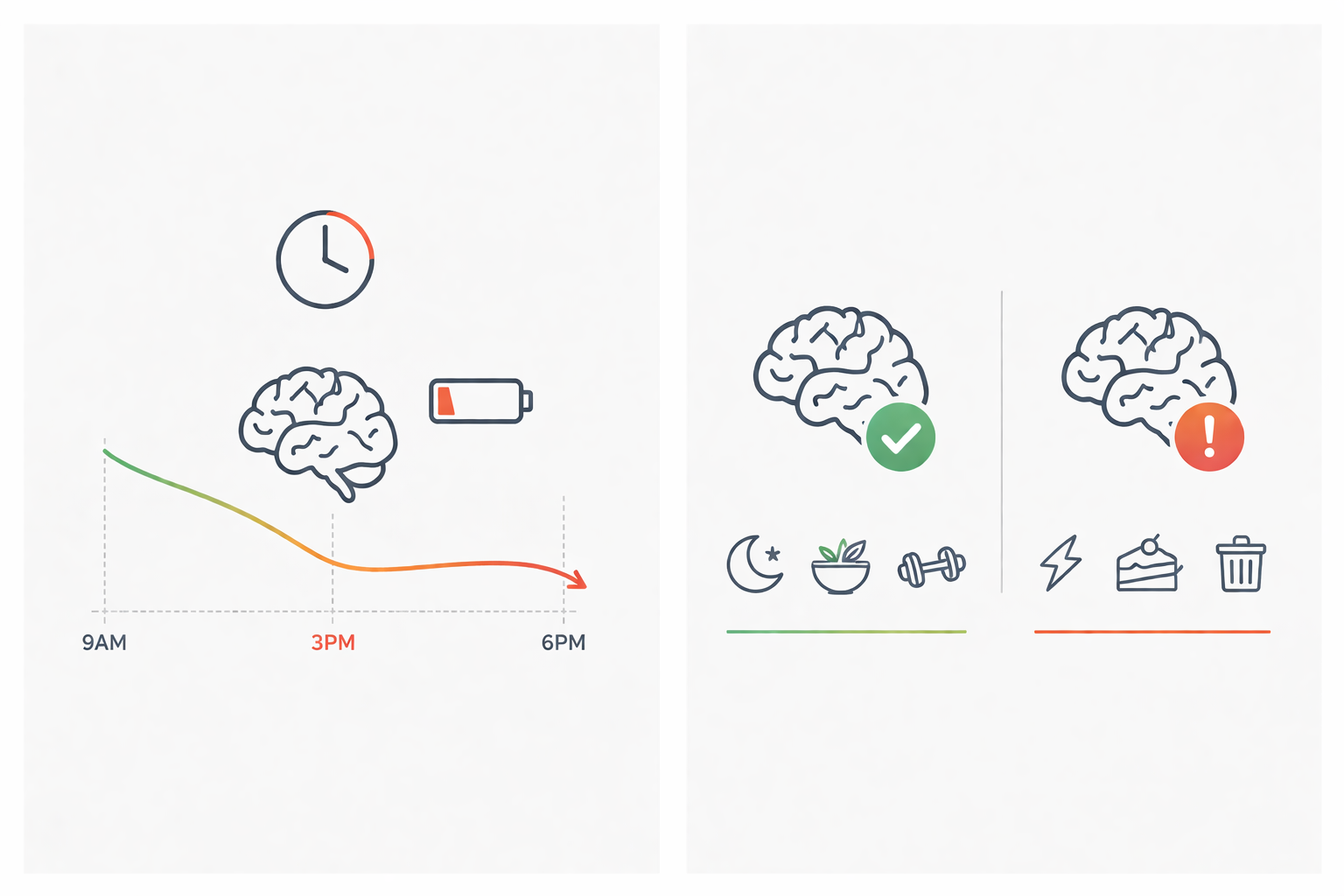
It’s a familiar pattern.
You start the day sharp.
Clear thinking. Focused. Productive.
Then somewhere between 2PM and 4PM, everything shifts.
- Focus drops
- Energy dips
- Decisions feel heavier
- Patience shortens
Most leaders assume it’s just a long day.
But it’s not.
The 3PM crash is not a time problem.
It’s a physiology problem.
1. The Circadian Dip You Can’t Outwork
Your body runs on an internal clock — your circadian rhythm.
And within this rhythm, there is a natural dip in alertness in the afternoon.
This is not optional.
It is built into your biology.
During this window:
- Alertness decreases
- Reaction time slows
- Cognitive performance declines
You can override it temporarily with caffeine or stress.
But you cannot eliminate it.
2. The Blood Sugar Trap After Lunch
Now layer in a typical leadership lunch:
- Quick meal
- High in refined carbohydrates
- Eaten between meetings
This creates a glucose spike, followed by a crash.
When the crash hits:
- The brain experiences a fuel dip
- Energy drops quickly
- Mental clarity declines
This is when:
- You reread emails multiple times
- You avoid complex decisions
- You feel mentally “flat”
It’s not laziness.
It’s unstable energy supply.
3. Decision Fatigue Builds Quietly
By mid-afternoon, you’ve already made dozens — sometimes hundreds — of decisions.
Each one draws on cognitive resources.
Over time:
- Mental bandwidth narrows
- Processing speed slows
- Shortcuts increase
This is known as decision fatigue.
And when combined with low energy, it creates the perfect environment for:
- Poor judgment
- Reactive thinking
- Reduced strategic clarity
4. Cortisol and the “Second Wind” Illusion
Some leaders don’t feel the crash.
Instead, they experience a late afternoon “second wind.”
This is not recovery.
It’s stress activation.
Cortisol rises again to keep you going.
This can feel like:
- Sudden alertness
- Restlessness
- Ability to push through
But it comes at a cost:
- Harder to fall asleep later
- Reduced sleep quality
- Greater fatigue the next day
You’re borrowing energy — not generating it.
5. Why This Matters for Leadership
Here’s the critical insight:
Your lowest-energy window is often when your highest-risk decisions are made.
This is when:
- Meetings run long
- Difficult conversations happen
- Strategic thinking is required
And yet, your brain is operating at reduced capacity.
This is how small errors become:
- Poor calls
- Miscommunication
- Missed opportunities
6. How High-Performing Leaders Manage the 3PM Window
Elite performers don’t fight their biology.
They work with it.
Here’s how:
1. Stabilize Your Lunch
- Prioritize protein, fiber, and healthy fats
- Reduce refined carbs
- Avoid heavy, fast spikes
2. Move After You Eat
Even a 5–10 minute walk can:
- Improve glucose control
- Boost circulation
- Restore alertness
3. Schedule Strategically
- Avoid critical decisions during your lowest energy window
- Use this time for lighter, operational tasks
4. Use Caffeine Intentionally
- Not too late
- Not as a crutch
- As a tool
5. Reset Your State
Short breaks:
- Breathing
- Movement
- Stepping away
These restore more than pushing through.
Final Thought: Your Energy Has a Rhythm — Respect It
The 3PM crash is not a weakness.
It’s a signal.
A signal that your body needs:
- Better fuel
- Better recovery
- Better alignment
Because leadership is not about being “on” all the time.
It’s about knowing:
When your brain is at its best — and when it’s not.
And managing your day accordingly.