
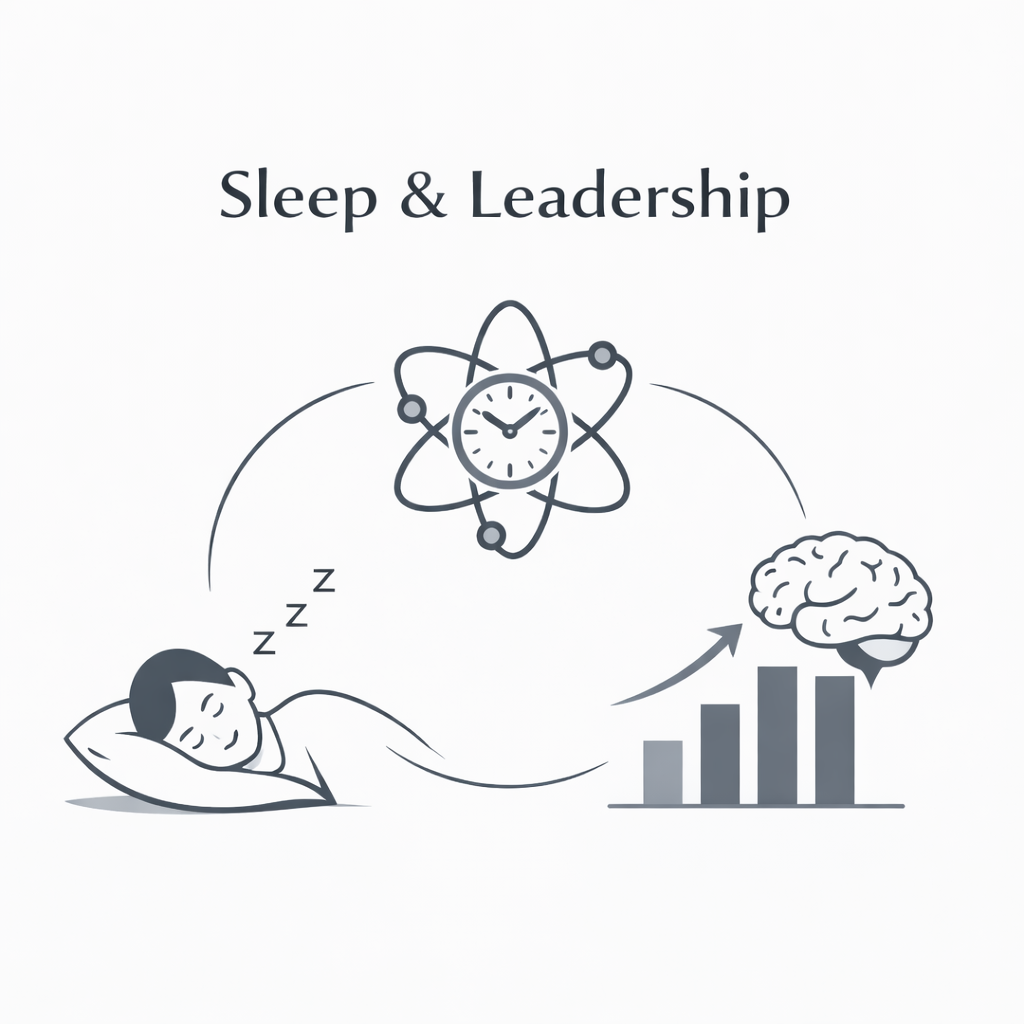
In leadership, the conversation usually revolves around strategy, execution, and productivity.
But there is one factor that silently shapes all three — and it rarely appears on the agenda of boardroom discussions.
That factor is sleep.
Sleep is often treated as a personal lifestyle choice, something that belongs outside the professional domain. Yet modern neuroscience tells us a very different story: sleep is one of the most powerful drivers of leadership performance.
If leadership is a high-performance role, then sleep is not optional recovery.
It is strategic infrastructure.
1. The Leadership Brain Runs on Sleep
Leadership demands constant cognitive effort.
Every day, leaders must:
- Analyze complex information
- Make high-stakes decisions
- Manage uncertainty
- Regulate emotions
- Guide and influence people
All of these functions rely heavily on the prefrontal cortex — the part of the brain responsible for reasoning, judgment, impulse control, and strategic thinking.
Sleep plays a crucial role in restoring and optimizing this region of the brain.
When sleep is adequate:
- Mental clarity improves
- Decision-making becomes more thoughtful
- Emotional regulation strengthens
- Creativity and insight increase
But when sleep is restricted, the prefrontal cortex becomes less effective. The brain shifts toward more reactive and emotionally driven responses.
In practical terms, a sleep-deprived leader is more likely to:
- React impulsively
- Misjudge risks
- Lose patience with colleagues
- Struggle to think strategically
This is not a question of discipline or mindset.
It is a biological constraint.
2. Sleep Is the Brain’s Overnight Reset
Sleep is not simply rest. It is an active biological process that restores the brain and body.
During deep sleep, the body performs critical repair functions:
- Tissue restoration
- Hormonal regulation
- Immune system strengthening
Meanwhile, the brain undergoes its own form of maintenance.
A specialized network known as the glymphatic system becomes highly active during sleep. It clears metabolic waste products that accumulate during waking hours, including proteins associated with cognitive decline.
Without sufficient sleep, these waste products accumulate. Over time, this contributes to mental fatigue, reduced clarity, and what many leaders describe as brain fog.
In other words, sleep is the brain’s nightly cleaning and reset cycle.
3. Sleep and Emotional Intelligence
Leadership is not only about intelligence. It is also about emotional regulation.
Leaders must navigate conflict, motivate teams, and remain composed under pressure. These capabilities depend heavily on the balance between two brain regions:
- The amygdala, which processes emotional reactions
- The prefrontal cortex, which regulates those reactions
When sleep is insufficient, communication between these regions weakens.
As a result:
- Emotional responses become amplified
- Stress reactions increase
- Patience declines
- Social sensitivity decreases
This explains why lack of sleep often leads to irritability, poor communication, and unnecessary workplace tension.
In contrast, well-rested leaders tend to demonstrate greater emotional agility, empathy, and composure.
4. Sleep and Decision-Making Quality
Decision-making is the core responsibility of leadership.
Yet research shows that sleep deprivation significantly affects how people evaluate risk and reward.
When individuals are sleep deprived, the brain becomes more sensitive to potential rewards while underestimating risks. This shift can lead to decisions that are overly aggressive or poorly considered.
In high-stakes environments, this can have real consequences:
- Strategic miscalculations
- Poor financial decisions
- Reduced ability to evaluate complex scenarios
Adequate sleep helps maintain balanced judgment, enabling leaders to evaluate opportunities and risks more accurately.
5. The Competitive Advantage of Rested Leaders
In many organizations, lack of sleep is worn as a badge of honor.
Late nights and early mornings are sometimes interpreted as signs of dedication. But increasingly, high-performing leaders are recognizing that chronic sleep deprivation is not a strength.
It is a performance liability.
Leaders who prioritize sleep often experience:
- More consistent energy throughout the day
- Greater mental clarity in complex discussions
- Better emotional control during stressful situations
- Improved creativity and problem-solving ability
These advantages accumulate over time, creating a meaningful difference in leadership effectiveness.
Final Thought: Rest Is a Leadership Skill
Leadership is frequently described as a marathon rather than a sprint.
Yet many leaders attempt to run that marathon while depriving themselves of the very resource that sustains long-term performance.
Sleep is not a luxury.
It is not a sign of weakness.
It is not lost time.
It is one of the most powerful strategic tools available to leaders.
Because in the end, the quality of leadership is deeply connected to the state of the brain that produces it.
And the brain performs best when it is well rested.